Vermont operates on Eastern Time, shifting between EST and EDT each year. This guide explains how seasonal clock changes influence time differences across the U.S. and worldwide.
States
What Time Is It in Vermont? - Time Zone Info
518 views
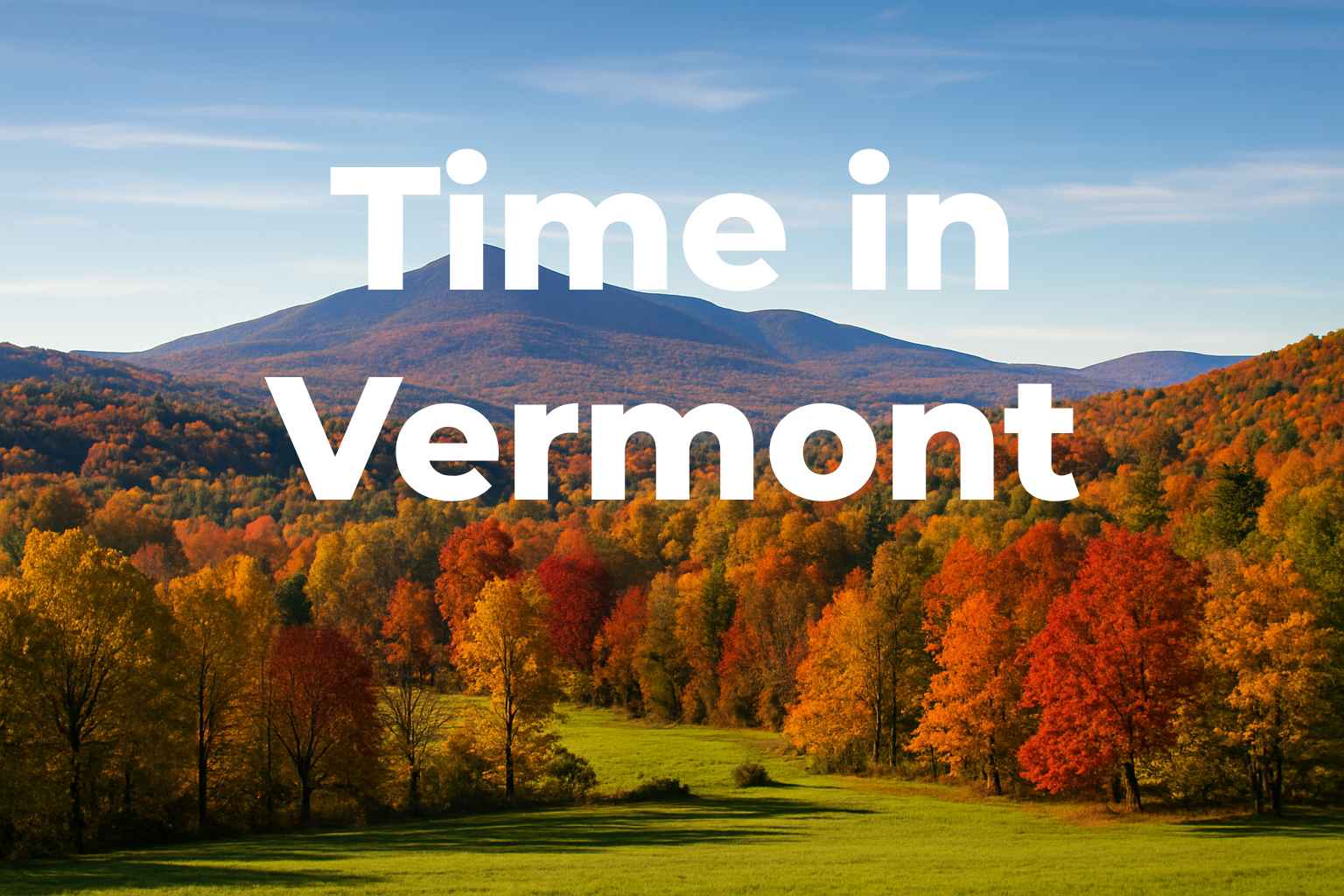
Vermont keeps a single statewide schedule in the Eastern Time Zone. Seasonal daylight changes shape outdoor lifestyles, regional travel, and timing across U.S. and global links.
Time in Vermont
When checking the current time in Vermont, many people refer to the state capital, Montpelier. All areas of Vermont use the identical seasonal clock schedule, ensuring no internal time variation across the state.
Vermont’s Time Zone
Vermont is situated in the Eastern Time Zone (ET), which includes much of the eastern United States and parts of eastern Canada and the Caribbean. Just like many regions, Vermont adjusts its clocks for Daylight Saving Time (DST).
The state uses two seasonal time labels:
Time Standard | Abbreviation | UTC Offset | Period of Use |
|---|---|---|---|
Eastern Standard Time | EST | UTC−5 | Late Fall to Early Spring |
Eastern Daylight Time | EDT | UTC−4 | Spring to Late Autumn |
EST (UTC−5): Traditional winter clock setting.
EDT (UTC−4): Activated when clocks advance by one hour to provide longer evening daylight.
Time Differences Inside the United States
Vermont runs 1 hour ahead of Central Time.
Vermont is 2 hours ahead of Mountain Time.
Vermont is 3 hours ahead of Pacific Time.
Vermont is generally 5 hours behind Hawaii-Aleutian Time, since Hawaii does not change clocks for DST.
Vermont shares an identical clock offset with New York, Washington D.C., and Florida throughout each season.
Major Vermont Cities and Their Time Schedule
All cities in Vermont follow the same seasonal clock standard:
City | Winter (EST) | Summer (EDT) | Reminder |
|---|---|---|---|
Burlington | UTC−5 | UTC−4 | Eastern seasonal shift |
South Burlington | UTC−5 | UTC−4 | Eastern seasonal shift |
Rutland | UTC−5 | UTC−4 | Eastern seasonal shift |
Barre | UTC−5 | UTC−4 | Eastern seasonal shift |
Montpelier | UTC−5 | UTC−4 | Capital, referenced for time |
St. Albans | UTC−5 | UTC−4 | Eastern seasonal shift |
Brattleboro | UTC−5 | UTC−4 | Eastern seasonal shift |
Bennington | UTC−5 | UTC−4 | Eastern seasonal shift |
Essex | UTC−5 | UTC−4 | Eastern seasonal shift |
Colchester | UTC−5 | UTC−4 | Eastern seasonal shift |
Comparing Vermont Time to Global Locations
Since world regions shift clocks differently—or not at all—the time gap from Vermont depends on the season.
Country & Capital | Time difference in EST | Time difference in EDT |
|---|---|---|
+5 hours | +4 hours | |
+10.5 hours | +9.5 hours | |
+14 hours | +13 hours | |
+6 hours | +5 hours |
Example:
In winter, 9:00 AM in Vermont = 2:00 PM in London.
In summer, 9:00 AM in Vermont = 1:00 PM in London.
Daylight Saving Time in Vermont
Vermont fully participates in DST:
Clock moves forward: Early Spring (UTC−4 begins)
Clock moves back: Late Autumn (returns to UTC−5)
These seasonal changes matter for:
✔ Flight and transport planning
✔ Online meetings with other time zones
✔ Digital services and real-time communication
✔ Cross-border work and coordination
Vermont’s clock will always shift on the same dates as the rest of the Eastern U.S.
Vermont: Geographic Snapshot
Category | Facts |
|---|---|
Region | Northeastern United States, New England |
Size | ~24,906 km² (~9,616 sq mi) |
Coordinates | ~42°44′N to 45°0′N, 71°28′W to 73°26′W |
Boundaries | Canada, New York, New Hampshire, Massachusetts |
Capital | Montpelier |
Recognized Cities | Burlington, Rutland, Barre, St. Albans, Brattleboro, Bennington |
Borders | |
Key Landforms | Green Mountains, Lake Champlain Valley, Taconic Range |
Highest Point | Mount Mansfield (~1,339 m / 4,395 ft) |
Water Systems | Lake Champlain, Connecticut River, Missisquoi River, Winooski River |
Climate Regions | Humid continental, alpine zones in mountain peaks |
Core Economic Sectors in Vermont
Agriculture: Known for dairy, maple syrup production, and organic farming.
Manufacturing: Machinery, metals, food processing, and precision components.
Tourism & Recreation: Ski destinations, scenic highways, autumn foliage, and lake activities.
Healthcare & Education: Large workforce concentration in medical services, research, and academic institutions.
Finance & Insurance Services: Regional banking, insurance operations, and investment sectors.
Renewable Energy: Hydropower, wind farms, biomass, and sustainability initiatives.
Forestry & Wood Products: Furniture, timber, paper goods, and craft wood industries.
Tech & Digital Innovation: Growing sector in software, cybersecurity, and remote digital employment.
Summary
Vermont functions year-round under Eastern Time, switching between EST (UTC−5) and EDT (UTC−4) due to Daylight Saving Time. The state maintains a unified seasonal clock schedule, which simplifies travel, business, and communication both within the U.S. and internationally. Its mountainous terrain, lake systems, and climate diversity support strong agriculture, year-round tourism, and expanding modern industries.