New Mexico follows the Mountain Time Zone, switching between standard and daylight time each year. Discover how seasonal clock shifts shape time differences across the U.S. and around the world from the Land of Enchantment.
States
What Time Is It in New Mexico? - Time Zone Info
459 views
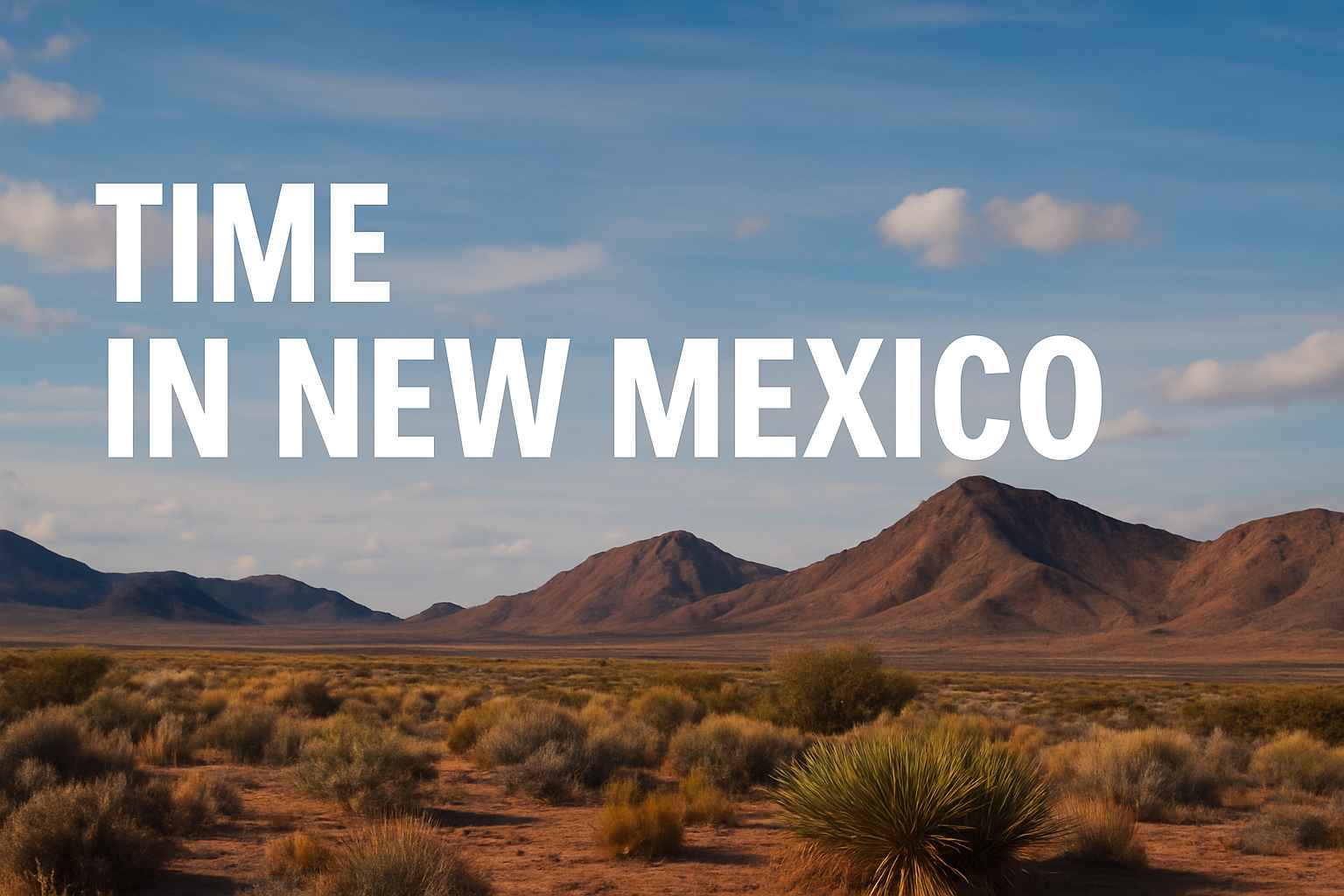
New Mexico follows Mountain Time, shifting between MST in winter and MDT in summer with full Daylight Saving cycles, shaping time gaps across the U.S. and globally.
Time in New Mexico
To determine the current time in New Mexico, many sources reference the state capital, Santa Fe. The state uses one unified time standard statewide, providing consistent local time across all cities and communities.
New Mexico’s Time Zone
New Mexico is located in the Mountain Time Zone (MT), shared with several southwestern and western U.S. states, northern Mexican regions, and parts of western Canada inland provinces. Time changes throughout the year due to Daylight Saving Time (DST).
Two key standards are applied:
Time Standard | Abbreviation | UTC Offset | Season |
|---|---|---|---|
Mountain Standard Time | MST | UTC−7 | Fall & Winter |
Mountain Daylight Time | MDT | UTC−6 | Spring & Summer |
MST (UTC−7): Standard time used in cooler months, when nights begin earlier across high-altitude regions.
MDT (UTC−6): Daylight time used after clocks move one hour forward in spring, extending daylight well into the evening.
Time Differences Within the United States
New Mexico is:
2 hours ahead of the Pacific Time (winter)
1 hour ahead of Pacific Daylight Time (summer)
1 hour behind Eastern Standard Time (winter)
2 hours behind the Eastern shift during peak DST overlap (spring–fall)
1 hour behind Central Standard Time
No clock overlap with the Hawaii-Aleutian Standard Time; usually 3–4 hours ahead by season
Neighboring states such as Arizona do not observe DST, so seasonal differences with Arizona vary by part of the year.
Major New Mexico Cities and Time Observance
City | Winter (MST) | Summer (MDT) | Notes |
|---|---|---|---|
UTC−7 | UTC−6 | Mountain Time | |
Las Cruces | UTC−7 | UTC−6 | Mountain Time |
Rio Rancho | UTC−7 | UTC−6 | Mountain Time |
Roswell | UTC−7 | UTC−6 | Mountain Time |
Farmington | UTC−7 | UTC−6 | Mountain Time |
Hobbs | UTC−7 | UTC−6 | Mountain Time |
Clovis | UTC−7 | UTC−6 | Mountain Time |
Santa Fe | UTC−7 | UTC−6 | State capital |
Comparing New Mexico Time with Other Countries
Because DST participation differs globally, time gaps shift by season.
Location | Difference During MST | Difference During MDT |
|---|---|---|
+7 hours | +6 hours | |
+12.5 hours | +11.5 hours | |
+14 hours | +13 hours | |
+8 hours | +7 hours | |
Example:
During MST → 8:00 AM in New Mexico = 3:00 PM in London.
During MDT → the same local hour aligns 1 hour earlier relative to London.
Daylight Saving Time in New Mexico
Begins: Early Spring → clocks advance 1 hour (MST → MDT)
Ends: Late Autumn → clocks return 1 hour (MDT → MST)
DST affects:
Long-distance travel timing through regional airports and highways
Cross-border communication with Mexico and Canada
Business calls for finance, energy, and research sectors
Evening outdoor tourism and cultural event planning
New Mexico: Geographic Context
Category | Details |
|---|---|
Location | Southwestern United States |
Area | ~314,917 km² (~121,590 sq mi) |
Coordinates | ~31.3°N–37.0°N, 103°W–109°W |
Borders | |
Capital | Santa Fe |
Largest Metro | |
Major Cities | Albuquerque, Las Cruces, Rio Rancho, Roswell, Farmington |
Major Landforms | Sonoran fringe deserts, Chihuahuan Desert basins, Sangre de Cristo Mountains |
Highest Point | Wheeler Peak (4,013 m / 13,167 ft) |
Lowest Point | Red Bluff Reservoir edge (856 m / 2,808 ft) |
Water Features | Rio Grande, Red Bluff Reservoir, Pecos River |
Major Industries in New Mexico
Technology & Research: Space science, national labs, AI research services, and advanced computing.
Aerospace & Defense: Aircraft testing, space launch services, astronaut training ecosystems.
Energy: Oil, natural gas, solar, and wind infrastructure in desert plains.
Tourism: Desert reserves, mountain towns, caves, stargazing destinations.
Agriculture: Chile peppers, pecans, onions, cotton, dairy, and ranching culture.
Film & Media: Growing regional production hub for western-style filming and digital storytelling.
International Trade: Active logistics through the southern border corridor with Mexico.
Summary
New Mexico keeps one statewide Mountain Time schedule, switching annually between MST (UTC−7) and MDT (UTC−6) for Daylight Saving Time. Seasonal clock behavior shapes national U.S. offsets and shifts global comparisons. With desert basins, mountain peaks, scientific labs, and cross-border routes, precise time sync is essential for travel, communication, and worldwide collaboration.