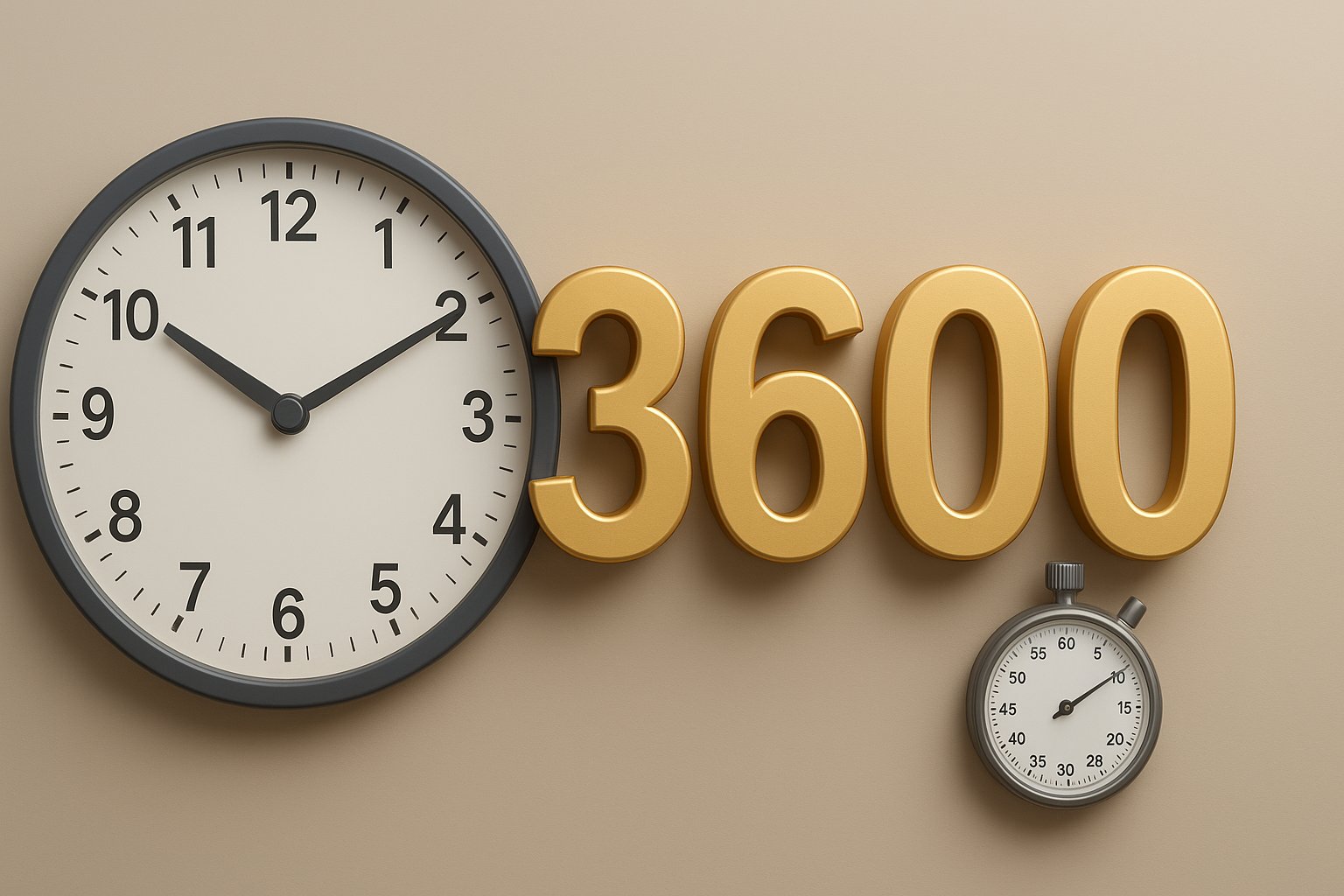
Discover why an hour equals 3,600 seconds and how this simple fact connects to science, technology, history, and everyday understanding of time.
Time is one of the most fundamental concepts that every person encounters daily. We measure it, plan our lives around it, schedule meetings, manage processes, observe the movement of planets, and even calculate the duration of impulses in quantum physics. The question “how many seconds are in an hour?” may seem elementary at first glance. Yet behind this simple arithmetic lies a deep history of the evolution of time measurement systems, scientific research, and countless practical applications in the modern world.
Knowing how many seconds are in an hour is essential in many fields. In programming, time is often measured in seconds because this is the most convenient unit for computer processes that require high precision. In science, seconds are used to measure oscillation periods, reaction speeds, or distances in light-years. In sports, it’s the standard unit that determines competition results to hundredths or thousandths of a second. And in time management, understanding this relationship helps structure one’s day and appreciate how each moment can be used efficiently.
The Basic Unit of Time
To understand how many seconds are in an hour, we must start with the basic definitions.
A second is the fundamental unit of time in the International System of Units (SI). It is defined as the duration of 9,192,631,770 periods of the radiation corresponding to the transition between two hyperfine levels of the ground state of the cesium-133 atom. This definition was adopted to make the unit maximally stable and independent of astronomical phenomena.
A minute consists of 60 seconds. It’s a convenient intermediate unit commonly used in daily life — for timing conversations, cooking processes, sports results, or short intervals of time.
An hour equals 60 minutes, or 3,600 seconds. The concept of the hour dates back to ancient civilizations, which divided the day into 24 equal parts. This division has survived to the present day and serves as a standard in the global system of time measurement.
Thus, the basic relationship looks like this:
1 minute = 60 seconds
1 hour = 60 minutes = 3,600 seconds
Calculating the Number of Seconds in an Hour
The calculation is straightforward, yet it represents the foundation of all time conversions:
1 hour=60 minutes×60 seconds per minute=3,600 seconds1 \text{ hour} = 60 \text{ minutes} × 60 \text{ seconds per minute} = 3,600 \text{ seconds}1 hour=60 minutes×60 seconds per minute=3,600 seconds
To explain this simply for children or beginners:
Imagine that each minute is a small container filled with 60 “time balls” — seconds. If we have 60 such containers (60 minutes), then altogether we have 60 × 60 = 3,600 balls, or seconds.
This principle makes it easy to switch between different time units — just multiply or divide by 60.
Extending the Calculation: Seconds in a Day, Week, Month, and Year
If one hour has 3,600 seconds, it’s easy to determine how many seconds are in longer periods:
In a day:
24 hours × 3,600 seconds = 86,400 seconds
In a week:
7 days × 86,400 seconds = 604,800 seconds
In a month (average, assuming 30 days):
30 × 86,400 seconds = 2,592,000 seconds
In a year (non-leap, 365 days):
365 × 86,400 seconds = 31,536,000 seconds
These calculations seem simple, yet they have real-world applications — for instance, in computer systems that measure time in seconds since a defined starting point (often referred to as an “epoch”).
Interesting Facts About Time
The Second as an SI Unit
The second is one of the seven base units in the International System. This means that all other time-, frequency-, or even distance-related units can be derived from it.
Atomic Timekeeping
The most precise clocks today are atomic. They measure atomic radiation frequencies and deviate by less than one second over millions of years. Such precision is crucial for navigation systems, communication synchronization, and scientific experiments.
Historical Origin of the Second
Originally, the second was defined as 1/86,400 of the mean solar day. However, because the length of the day varies due to Earth’s rotational irregularities, the atomic definition was adopted to ensure stability and universality.
Leap Seconds
Due to irregularities in Earth’s rotation, “leap seconds” are occasionally added to synchronize atomic time with astronomical time. This correction occurs a few times per decade.
The Second and the Speed of Light
The definition of the meter also depends on the second — it is the distance light travels in a vacuum in 1/299,792,458 seconds. Thus, even a unit of length is tied to time.
Examples of Use
1. In Programming
In the digital world, time is most commonly measured in seconds because it’s both precise and computationally efficient. Timekeeping systems count the number of seconds that have elapsed since a specific reference point, which simplifies comparisons, timer functions, and duration calculations.
For example, to find how many hours have passed between two events, a program simply divides the difference in seconds by 3,600.
2. In Physics
The second is crucial in nearly all physical laws. Velocity, acceleration, frequency, and oscillation period — all rely on time measurement. In quantum mechanics, thermodynamics, or astrophysics, even microseconds can be critical.
3. In Sports
On racetracks, in swimming pools, or at ski competitions, results are often determined by tenths or thousandths of a second. Modern electronic timing systems capture events so precisely that the human eye cannot perceive the difference.
4. In Everyday Life
From brewing coffee to setting an alarm clock or tracking a commute, we constantly interact with seconds. Timers, activity trackers, and kitchen clocks all operate using the same fundamental constant — 3,600 seconds in an hour.
5. In Time Management
Although most people plan their days in hours or minutes, it is the second that reflects the true granularity of time. Realizing that an hour consists of 3,600 equal moments helps one appreciate how limited this resource truly is.
The Philosophical Aspect of Time
A second is both an infinitesimally small fragment of our lives and the cornerstone of our perception of duration. Humanity has spent millennia striving to measure time more precisely — from the shadows of sundials to the oscillations of atoms. Gradually, the concept of a “second” evolved from a simple numerical fraction into a symbol of precision, rhythm, and order.
When we say an hour contains 3,600 seconds, we are not merely stating a mathematical fact. We are expressing a cultural heritage shaped by centuries of astronomical observation, mathematical reasoning, and scientific refinement. This number reflects a harmony between the natural rhythms of the universe and human attempts to quantify them.
The Symbolic Meaning of 3,600
The number 3,600 is interesting from a mathematical standpoint: it is the product of two squares — 60 × 60, or 6² × 10². Its structure allows easy divisibility by many integers — 2, 3, 4, 5, 6, 8, 10, 12, 15, 20, 30, and others. This makes it ideal for practical use. Not coincidentally, the base-60 (sexagesimal) system, which originated with the Sumerians, became the foundation for modern timekeeping and angular measurement.
The Evolution of the Second
In ancient times, people relied on natural cycles — sunrise and sunset, the phases of the moon, and the seasons. Science later transformed the second into a universal and reproducible unit, independent of celestial mechanics. Today, a second exists as an abstract yet precise standard that can be replicated anywhere in the universe with appropriate technology.
Thus, when we speak of 3,600 seconds in an hour, we’re not just referring to a convenient division — we’re acknowledging a mathematical order underlying the flow of time.
Conclusion
At first glance, the answer to “how many seconds are in an hour?” seems simple — 3,600. But behind this number lies a rich story of scientific evolution, mathematical elegance, technological innovation, and philosophical reflection on the nature of time.
The second is a bridge between the cosmic and the mundane, between abstraction and practicality. When we divide an hour into 3,600 equal parts, we are not just counting — we are applying one of humanity’s most refined and universal measurements.
Knowing how many seconds are in an hour is not just arithmetic. It’s an appreciation of how humanity has learned to organize and quantify time — the most valuable and, at the same time, the most elusive resource we possess.