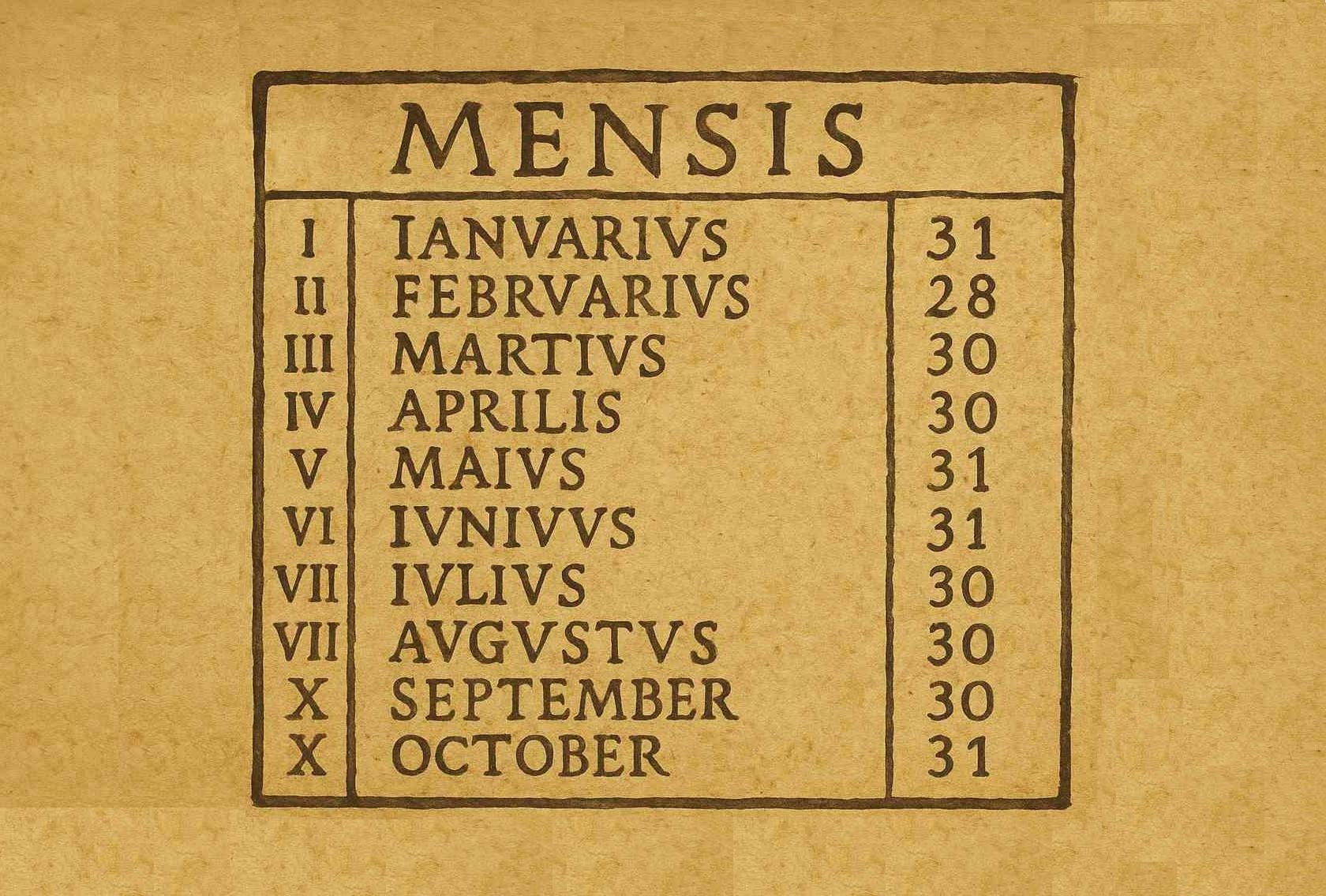
Discover why a year has 365 or 366 days, how leap years work, and how Earth’s orbit shapes the calendars we use today.
When we talk about a “year,” it’s important to understand that there are several ways to measure it. In everyday life, we use the calendar year, which can be either common or leap. A common year has 365 days, while a leap year has 366.
However, in astronomy, there are other definitions — such as the sidereal year, which relates to Earth’s motion relative to the stars, and the tropical year, which corresponds to the seasonal cycles. The tropical year forms the foundation of the modern calendar system because it measures the time it takes the Sun to return to the same point on the ecliptic as in the previous year — that is, the renewal of the seasonal cycle.
| Days | Hours |
|---|
Common Year | | |
Leap Year | | |
How Many Days Are in a Common Year?
A common year consists of 365 days. This number seems natural, but it’s actually an approximation of the true length of the year. The Earth completes one full orbit around the Sun in about 365 days and nearly 6 hours. This “extra” fraction of a day — about 0.242 days — is the reason we periodically add an extra day to the calendar to prevent a gradual drift between the calendar and the actual solar year.
Table 1. Number of Days and Hours in a Common Year (365 days)
№ | Month | Days | Hours (×24) |
|---|
1 | January | 31 | 744 |
2 | February | 28 | 672 |
3 | March | 31 | 744 |
4 | April | 30 | 720 |
5 | May | 31 | 744 |
6 | June | 30 | 720 |
7 | July | 31 | 744 |
8 | August | 31 | 744 |
9 | September | 30 | 720 |
10 | October | 31 | 744 |
11 | November | 30 | 720 |
12 | December | 31 | 744 |
Summary
Thus, a common year has 365 days, equal to 8,760 hours. This duration serves as the standard for most calendar and scientific calculations.
Number of Days in Each Year (2025–2050)
Year | Days | Leap Year? |
|---|
2025 | 365 | No |
2026 | 365 | No |
2027 | 365 | No |
2028 | 366 | Yes |
2029 | 365 | No |
2030 | 365 | No |
2031 | 365 | No |
2032 | 366 | Yes |
2033 | 365 | No |
2034 | 365 | No |
2035 | 365 | No |
2036 | 366 | Yes |
2037 | 365 | No |
2038 | 365 | No |
2039 | 365 | No |
2040 | 366 | Yes |
2041 | 365 | No |
2042 | 365 | No |
2043 | 365 | No |
2044 | 366 | Yes |
2045 | 365 | No |
2046 | 365 | No |
2047 | 365 | No |
2048 | 366 | Yes |
2049 | 365 | No |
2050 | 365 | No |
What Is a Leap Year?
A leap year is a year in which one extra day — February 29 — is added to the usual 365 days. Therefore, a leap year has 366 days. This adjustment compensates for the additional fraction of a day that accumulates each year.
Table 2. Number of Days and Hours in a Leap Year (366 days)
№ | Month | Days | Hours (×24) |
|---|
1 | January | 31 | 744 |
2 | February | 29 | 696 |
3 | March | 31 | 744 |
4 | April | 30 | 720 |
5 | May | 31 | 744 |
6 | June | 30 | 720 |
7 | July | 31 | 744 |
8 | August | 31 | 744 |
9 | September | 30 | 720 |
10 | October | 31 | 744 |
11 | November | 30 | 720 |
12 | December | 31 | 744 |
Summary
The additional 24 hours result from the accumulation of roughly one-quarter of a day over each of four common years. Adding this day keeps the calendar synchronized with Earth’s orbital position.
Rules for Determining a Leap Year
The rule for leap years may seem straightforward, but it has a few refinements. The main idea is: a year is leap if it’s divisible by 4, except for century years, which must also be divisible by 400 to qualify as leap years.
In other words:
If a year is divisible by 4, it’s a leap year.
If a year is divisible by 100, it’s not a leap year.
If a year is divisible by 400, it is a leap year again.
This system keeps the calendar year closely aligned with the tropical year (365.24219 days). The deviation between the calendar and the actual solar year is only one day every 3,300 years, an impressive level of precision for civil timekeeping.
Why Add the Extra Day (February 29)?
Adding February 29 corrects the discrepancy between the calendar year and Earth’s orbital period. Without this correction, the seasons would slowly shift: after several centuries, winter would begin in calendar March, and summer in September.
The extra day restores alignment between calendar dates and the planet’s true position in its orbit. February was chosen because it is the shortest month, minimizing disruption to existing cycles — particularly lunar ones, which were used in earlier calendar systems.
Historical Context
Calendar Reforms
The first systematic attempt to align the year with the solar cycle was the Julian calendar, introduced in ancient Rome. It used a simple rule: every fourth year is a leap year. While this significantly improved accuracy, it was not perfect.
The Julian year had an average length of 365.25 days, whereas the actual tropical year is slightly shorter — about 365.24219 days. The difference seems tiny, but over centuries it accumulated, and the calendar gradually drifted from the real solar year.
To correct this drift, a reform introduced the Gregorian calendar, which refined the leap year rule by adding exceptions for century years and the special case of multiples of 400. This adjustment nearly eliminated the accumulated error.
Why It Was Necessary to Refine the Number of Days in a Year
Refining the year’s length became necessary because important astronomical events, such as the spring equinox, were gradually shifting from their expected calendar dates. This caused difficulties in religious observances and agricultural planning.
The new calendar restored the proper alignment between the seasons and the dates, which was crucial for both agriculture and timekeeping in general.
Other Types of Years
Although the calendar year is the one we use daily, astronomy defines several types of years to describe Earth’s motion with greater precision. These definitions reveal why the calendar year is only an approximation of the planet’s orbital cycle.
Sidereal Year (~365.25636 days)
The sidereal year is the time it takes the Earth to complete one orbit around the Sun relative to the fixed stars. It’s a more “cosmic” unit of measurement, as distant stars serve as a stable frame of reference.
A sidereal year lasts about 365.25636 days, slightly longer than both the calendar and tropical years. The difference arises from the precession of Earth’s axis — a slow, circular motion that changes the orientation of Earth’s rotation axis over time. Because of this, the Sun’s apparent position relative to the stars doesn’t perfectly match its seasonal position.
Tropical Year (~365.24219 days)
The tropical year is the interval between two successive spring equinoxes. It determines the seasonal cycle — the progression of spring, summer, autumn, and winter.
Its duration is approximately 365.24219 days, and this value forms the basis of the modern Gregorian calendar. The system of leap years ensures that the average calendar year remains very close to this length.
Astronomical vs. Calendar Year — The Difference
An astronomical year represents the physical period of Earth’s revolution around the Sun — something that can be measured with great precision. A calendar year, however, is a human construct designed for convenience. Its duration is adjusted to approximate astronomical reality, but it remains a simplification.
Calendars are influenced not only by astronomical phenomena but also by cultural, religious, and historical factors. As a result, different civilizations have developed distinct systems of timekeeping — solar, lunar, and lunisolar — each attempting to represent the natural rhythm of our planet in its own way.
Conclusion
To summarize:
A common year has 365 days, while a leap year has 366 days. The additional day — February 29 — compensates for the small mismatch between the calendar and the tropical year’s actual duration.
This system, established centuries ago, remains remarkably effective. It allows us to synchronize human activity, holidays, scientific observations, and historical records with the natural cycle of Earth’s motion.
The accurate counting of days is vital not only for calendars but also for science as a whole. From astronomy to geophysics, from climatology to time synchronization systems — all depend on a precise understanding of how our planet moves and how long one full orbit takes.
Without this alignment, it would be impossible to accurately predict celestial motions, plan space missions, maintain global positioning systems, or even keep precise time in everyday life.