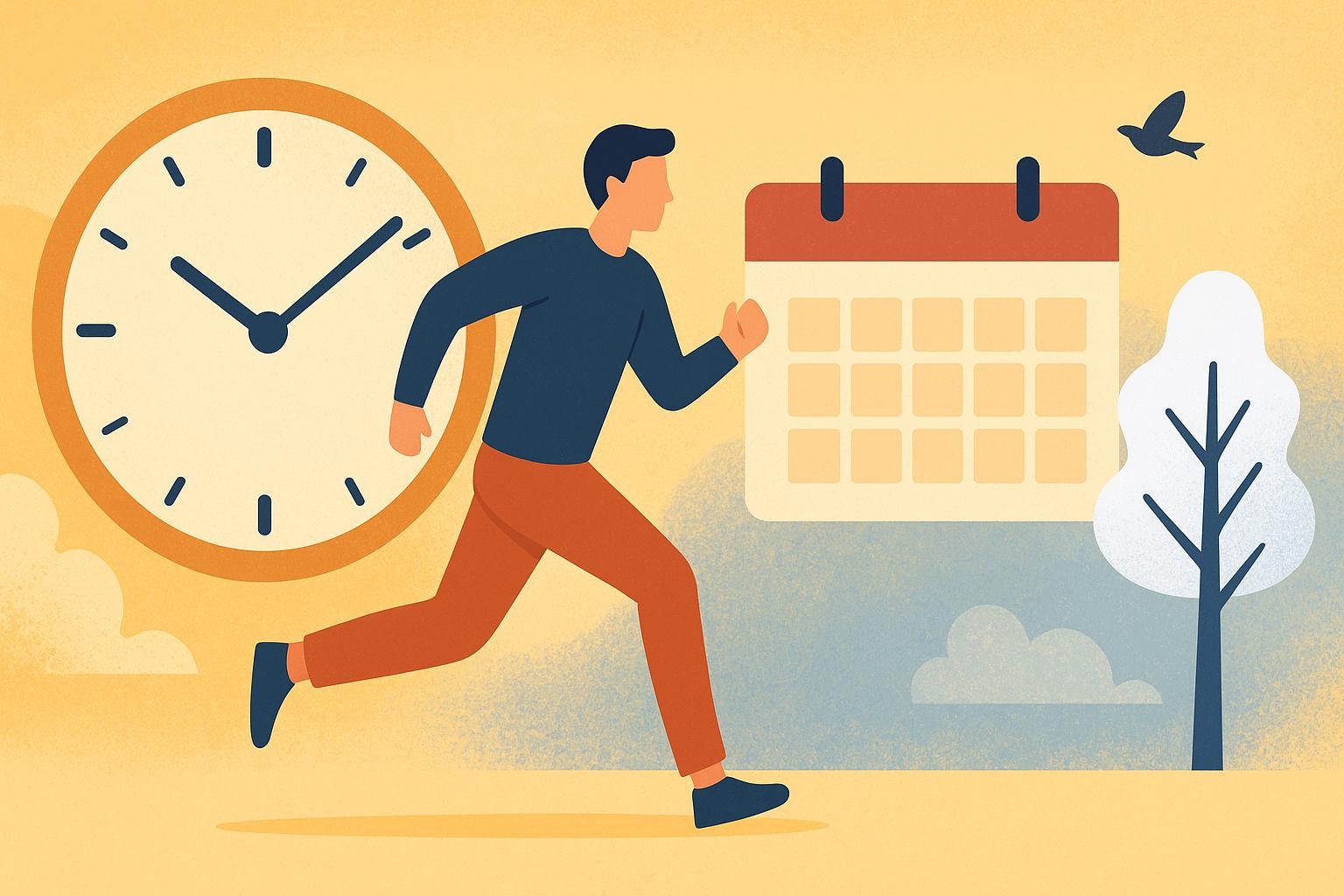
As we grow older, time feels like it slips away faster. This article explores the science and psychology behind that perception—and shares ways to slow it down and make life feel richer.
"It feels like just yesterday it was summer ☀️, and now snow ❄️ is falling outside and Christmas songs 🎶 are playing."
Almost every adult has caught themselves thinking this at least once.
Time in Childhood 🧒
As children, days seemed endless:
summer vacations lasted forever 🏖️,
waiting for a birthday was almost unbearable 🎂,
a year felt like a huge span of life 📅.
Time in Adulthood 👩🦳👨🦳
With age, everything changes:
What We’ll Cover in This Article 📖
We’ll explore:
And most importantly — we’ll find out if it’s possible to “slow down” time ⏳ and make life feel more vivid and fulfilling.
Physiological Reasons 🧬
Metabolism and Biological Rhythm ⏱️
As we age, our bodies undergo natural changes.
In youth ⚡:
the heart beats faster ❤️,
metabolism is more active 🔥,
the nervous system responds more sharply ⚡.
This creates the impression that more events are happening around us.
With age, processes slow down 🐢:
We are like passengers 🚆 on a train that gradually gains speed — it feels as if time is “rushing.”
Fewer New Impressions ✨
Physiology is also tied to the number of impressions we experience.
Each “first” activates the brain and creates new neural connections 🧠.
The brain conserves energy and compresses information, making time feel shorter.
Neuroplasticity and Age-Related Changes 🧠
Neuroplasticity is the brain’s ability to adapt, form new connections, and change.
In youth 🚀:
In maturity 🌿:
Psychological Aspects 🪞
The Proportional Time Theory ⏳
One of the most popular explanations is the “proportional time theory.”
👉 That’s why the older we get, the shorter a year feels.
Less Novelty ✨
In childhood, we experience many “firsts”:
Each new experience enriches life and stretches time.
In adulthood, everyday life becomes repetitive 🔁, and the brain starts compressing events — making years feel shorter.
Routine and Repetition 📅
Familiar feeling: a week flew by “like one day”?
That’s the effect of routine:
if days are almost identical,
the brain doesn’t separate them in memory,
as a result, the entire week is perceived as one short moment ⚡.
The Role of Memory and Perception 🧩
How Memories Are Formed 🧠
Our memory is not a video camera 🎥. It doesn’t store everything, only:
👉 That’s why a vacation day full of events 🏖️ feels long, while a month of office work 💼 can shrink into a blur.
Travel Example ✈️
Many notice this:
Why? Because each day brings:
The brain works hard to process this information, and time stretches in our perception ⏳.
Modern Lifestyle and Technology 📱🌍
Fast Information Consumption ⚡
We live in an era of information overload:
social media 📲,
news 📰,
videos 🎬.
Everything happens quickly and in abundance, creating the feeling that events follow each other instantly. We adapt to this pace and begin to feel like life itself is “flying” 🚀.
Multitasking and Lack of Focus 🔄
Every day we rush:
work 💼,
household chores 🏠,
messages and calls 📞💬.
As a result, we focus less on the present moment. When attention is scattered, time slips away unnoticed ⏱️.
Social Media as “Time Eaters” 🕳️🐇
How many times have you sat down to “scroll for a minute” 📲 — only to find an hour ⏰ had passed?
This is another way modern technology steals our attention and creates the illusion of time speeding up.
Can We Slow Down Time? ⏳🌿
The good news is yes! 🙌 Even though time passes objectively the same, we can change our perception of it.
🧘 Mindfulness Practices
Mindfulness helps “return” our attention to the present moment:
Such moments make life fuller and seem to stretch time.
📓 Journaling
Writing things down helps:
record events 🖊️,
make each day unique ✨.
Even a few sentences at night can change how we perceive time lived.
🌍 Trying New Things
Every novelty creates new impressions — and slows time down.
🎉 Creating Rituals and Traditions
Small celebrations, family traditions 👨👩👧👦, themed evenings 🍷🎶 — all of these form bright memories and add “anchors” to life.
🌸 Being “Here and Now”
Not living only by plans 🗓️ or memories 🖼️.
The present moment is the only one we truly have.
Conclusion ✨⏳
⏱️ Time Is Unchanging
Objectively, it’s always the same:
24 hours a day 🌞🌙,
365 days a year 📅.
But our perception is different at 10, 30, or 60. This is the result of:
🌈 Why We Shouldn’t Be Sad
The phrase “time flies” shouldn’t cause sadness.
On the contrary, it’s a reminder that we can:
add more new impressions ✈️🎶,
pay attention to details 🌸,
value the present moment ❤️.
🛤️ Our Own Rhythm
Life doesn’t have a “slow down” button ⏸️.
But we can create our own rhythm, filled with mindfulness and novelty.
Then time becomes our ally 🤝, not our enemy.