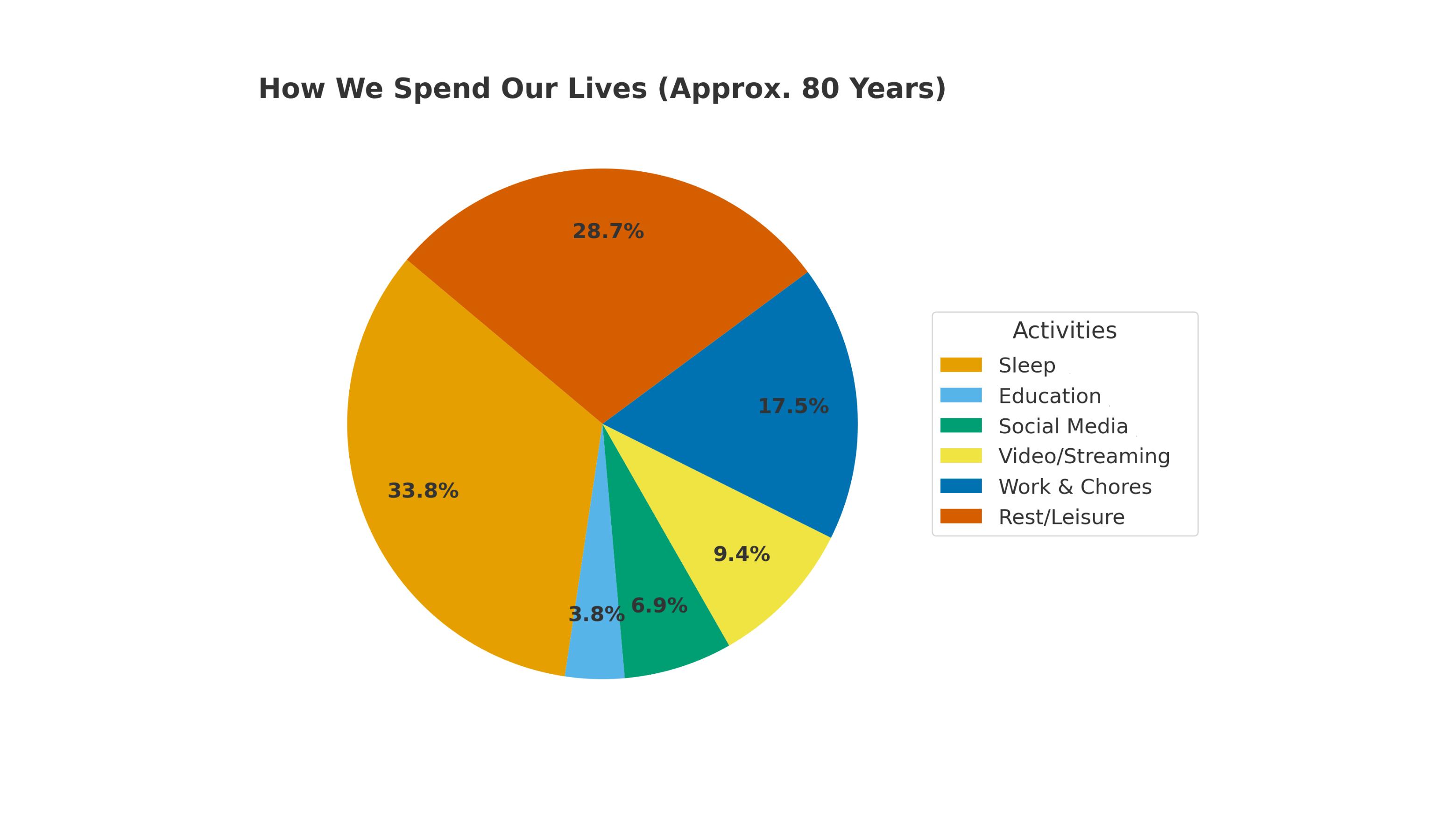
A deep look at how our lives are divided between sleep, work, education, screens, and rest—revealing how much time is truly left for growth and meaning.
I. Introduction 🌎
Time is the most valuable resource we have, yet it often feels like it slips through our fingers. Daily life is shaped by busy work schedules, school obligations, technology, and entertainment, and many people rarely stop to consider how much of their life is consumed by routine activities.
Understanding where our hours go is essential for making conscious choices about how we live. This article will explore the approximate time spent on key life activities—😴 sleep, 🎓 education, 📱 social media, 🎬 video consumption, and 🏖 rest—and reveal how much time is truly left for personal growth and fulfillment.
The goal is simple: to look honestly at our time budget and realize that by planning better, we can reclaim parts of our lives that often vanish unnoticed.
II. Sleep 😴
Sleep is essential for physical and mental health. Adults typically need 7–9 hours per night. Surveys show the average adult sleeps about 7.1 hours per night.
Daily: ~7 hours
Yearly: 7 × 365 ≈ 2,555 hours
Lifetime (80 years): ≈ 204,400 hours
That’s about 27 years of life spent sleeping! Not wasted—it fuels memory, immunity, and emotional balance. But it’s eye-opening to realize we spend nearly a third of life in bed. 🛏
👉 Takeaway: Since sleep consumes so much of life, improving quality matters as much as quantity.
III. Education in School and University 🎓
Education shapes us, but it’s also time-intensive. Children spend about 13 years in school, then often 4 years in college (sometimes more with graduate study).
School (K–12): ~6.5 hours/day × 180 days/year × 13 years ≈ 15,210 hours
College: Classes + study ≈ 5,760 hours
Total ≈ 21,000 hours 📚
That’s a concentrated period in youth—an investment of time to prepare for decades of work and personal growth.
👉 Takeaway: Education may feel endless when you’re in it, but it’s only a fraction of life—and it pays lifelong dividends.
IV. Social Media 📱
Social media has become a huge part of modern life. The average person spends about 2 hours 14 minutes daily scrolling.
That’s 5.5 years of life—and for heavy users, it’s double. 😳
Impact: Overuse can raise anxiety and hurt productivity, but it also connects us socially and professionally.
👉 Takeaway: Social media isn’t inherently bad—it’s about whether your scrolling matches your goals and values.
V. Video Watching 🎬
From binge-worthy shows to short-form clips, video content is a favorite pastime. Adults average 3 hours/day on TV or streaming.
That’s 7.5 years of life watching screens.
For perspective: bingeing a hit series that takes 100 hours is just a tiny drop compared to decades of viewing. 🍿
👉 Takeaway: Streaming can easily become a “silent thief” of time. Mindful viewing is key.
VI. Rest and Leisure 🏖
Rest isn’t just doing nothing—it includes hobbies, exercise, travel, or family time. Surveys show people average 5.2 hours/day on leisure and sports. But when you subtract sleep, work, commuting, chores, and screen time, quality rest often feels scarce.
Work + commute: ~8.5 hrs/day ≈ 2,210 hrs/year
Chores, errands, caregiving: ~1,200 hrs/year
What’s left is limited—often just a couple of free hours per day. 😔
Problem: Many feel overworked and under-rested, with over half of adults reporting frequent stress.
Tips:
Swap passive rest (endless scrolling) for active rest (sports, hobbies).
Schedule downtime like appointments.
Set boundaries with work and devices. 📵
👉 Takeaway: Rest is less about how much time you have, and more about how intentionally you use it.
VII. Conclusion ✨
Here’s how a typical 80-year lifespan breaks down:
Sleep: ~27 years
Education: ~3 years (concentrated in youth)
Social Media: ~5.5 years
Video/Streaming: ~7.5 years
Work & Chores: ~13–15 years
Rest/Leisure: scattered, often less than we hope
The math shows: much of life is already spoken for. What remains—our true free time—is precious and limited.
🌟 Why it matters: Without planning, decades can slip away on autopilot. The goal isn’t to eliminate sleep, work, or even streaming, but to align time with what truly matters: relationships, growth, and meaning.
📌 Call to Action: Track your daily hours. Ask: Am I spending time, or investing it? Small adjustments today can add up to years reclaimed tomorrow. Life isn’t just about passing time—it’s about making time count. ⏰💡
*All data is approximate and may not reflect your personal reality.