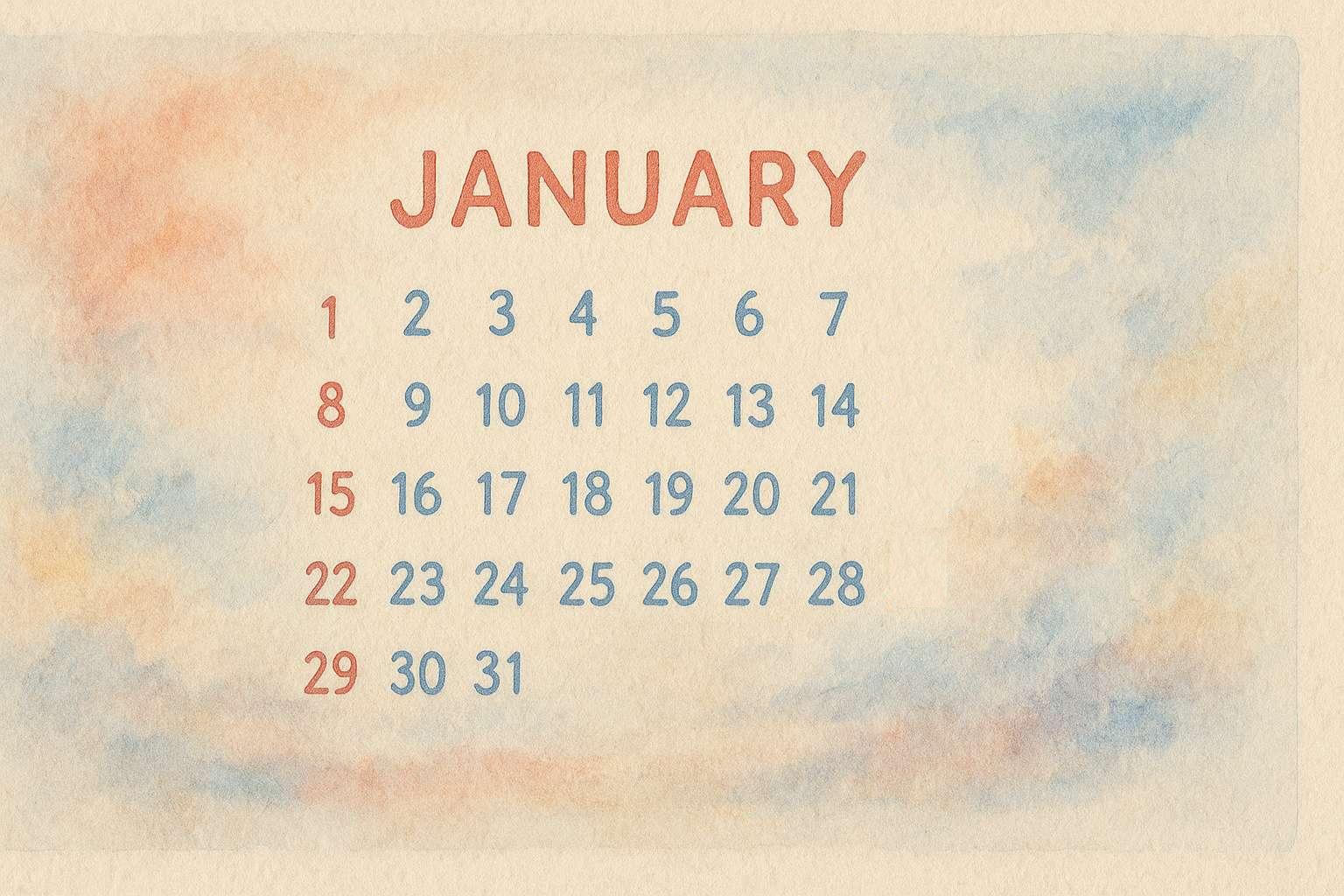
A clear overview of how months differ in length, weeks, and seasons — exploring the structure of time, leap years, and the natural rhythm of the calendar year.
At first glance, months may seem like equal slices of the same calendar pie — twelve convenient sections dividing the year into manageable units. Yet, a closer look reveals that months are far from uniform. They differ in their length, placement within the seasons, number of calendar weeks, and even their behavior during leap years.
This variation is not accidental; it reflects centuries of adaptation to the rhythm of Earth’s orbit and humanity’s need to measure time with precision and practicality. A month, after all, is both a mathematical construct and a lived experience — influencing how we plan, work, celebrate, and rest.
The Structure of a Month
In the modern Gregorian calendar, a month is a unit of time designed to divide the year into roughly equal parts. A typical year has 12 months, totaling 365 days, while a leap year includes 366 days to keep our calendar aligned with the solar year.
Mathematically, the average month length is about 30.4 days, though actual months vary between 28 and 31 days. When converted into weeks, that equals about 4 to 5 weeks per month, which is why monthly and weekly cycles often misalign.
Here’s a simplified overview:
Month | Days | Approx. Weeks | Quarter | Season (Northern Hemisphere) |
|---|
January | 31 | 4.4 | Q1 | Winter |
February | 28 / 29 | 4.0 | Q1 | Winter |
March | 31 | 4.4 | Q1 | Spring |
April | 30 | 4.3 | Q2 | Spring |
May | 31 | 4.4 | Q2 | Spring |
June | 30 | 4.3 | Q2 | Summer |
July | 31 | 4.4 | Q3 | Summer |
August | 31 | 4.4 | Q3 | Summer |
September | 30 | 4.3 | Q3 | Autumn |
October | 31 | 4.4 | Q4 | Autumn |
November | 30 | 4.3 | Q4 | Autumn |
December | 31 | 4.4 | Q4 | Winter |
Together, these months form the rhythm of the year — alternating between shorter and longer intervals that shape both personal and collective timekeeping.
How Months Change by Length
One of the most obvious differences between months lies in how long they are. Some last 31 days, others 30, and February — the outlier — has 28 days most years and 29 during leap years.
This irregularity stems from balancing the solar year (about 365.24 days) with a calendar of whole days. The result is a pattern where certain months are extended or shortened to keep the system synchronized over time.
In daily life, this difference has practical effects:
Planning and productivity: A shorter month like February naturally includes fewer workdays, influencing scheduling, payroll, and project deadlines.
Behavioral patterns: Many people notice that it feels easier to complete “30-day challenges” in shorter months or that longer months stretch the perception of time.
The varying lengths add texture to the calendar, preventing monotony and subtly shaping the flow of the year.
Weeks Within Months
Months and weeks are two of the most commonly used calendar units, yet they rarely align perfectly. A week always has seven days, but because months have uneven lengths, their overlap with the weekly cycle shifts continuously.
For instance, a 31-day month can span over five Mondays, while a 30-day month might have only four. This small difference can significantly affect scheduling — particularly for payroll periods, business reporting, or repeating appointments.
The ISO week system, widely used in international standards, assigns each week a number (from Week 1 to Week 52 or 53). According to this method, Week 1 is the week containing the year’s first Thursday. This standardization allows organizations and researchers to compare time periods consistently across years — even when months begin or end midweek.
The disconnection between months and weeks is why calendars rarely look symmetrical. Each year, the same month starts on a different weekday, producing a constantly shifting rhythm that keeps calendars dynamic.
The Leap Year Effect
Every four years, something interesting happens: February gains an extra day. A leap year extends the calendar to 366 days, realigning our timekeeping with Earth’s orbital position around the Sun.
Without this adjustment, the calendar would slowly drift out of sync with the seasons — by about one day every four years. Over centuries, this would mean winter could eventually fall in what the calendar calls July.
The extra day (February 29) subtly changes how months and weeks interact. For example:
Year | Leap Year? | Days | February Days | Notes |
|---|
2023 | No | 365 | 28 | Common year |
2024 | Yes | 366 | 29 | Leap year |
2025 | No | 365 | 28 | Common year |
2026 | No | 365 | 28 | Common year |
2027 | No | 365 | 28 | Common year |
2028 | Yes | 366 | 29 | Leap year |
2029 | No | 365 | 28 | Common year |
2030 | No | 365 | 28 | Common year |
Leap years cause dates to “shift” in the weekly cycle. For instance, if your birthday falls on a Monday one year, it will fall on a Tuesday the next — and after a leap year, on a Wednesday. Over time, this creates the rolling pattern that defines our perception of repeating dates.
How Months Align with the Seasons
Beyond mathematics, months are deeply tied to the seasons — a connection that defines both natural cycles and cultural traditions.
There are two main ways to divide the year into seasons:
Astronomical seasons, based on Earth’s position relative to the Sun (equinoxes and solstices).
Meteorological seasons, which group months into consistent three-month blocks for easier climate tracking.
In the Northern Hemisphere (where the U.S., U.K., and most of Europe lie), the pattern looks like this:
Winter: December, January, February
Spring: March, April, May
Summer: June, July, August
Autumn (Fall): September, October, November
In the Southern Hemisphere (such as Australia), these alignments reverse — December marks summer, not winter.
Understanding this alignment helps in seasonal planning: scheduling outdoor activities, vacations, agricultural work, or business cycles. Companies often structure their fiscal operations around quarters (Q1–Q4), which correspond to three-month segments — effectively translating seasonal change into economic rhythm.
Comparing Month Lengths in Real Life
In practice, people experience the differences between months in subtle but consistent ways. A month’s length, position in the year, and holiday density all affect how it “feels.”
February, with its 28 days, often feels fleeting — a rush between the resolutions of January and the longer days of March.
Months with 31 days, like July or October, tend to feel fuller, offering an extra weekend or workday.
Transitional months, like April or September, bridge seasons and often feel like natural points for reflection or reset.
Understanding Time in Practice
Months are more than just names on a page — they are functional building blocks of the year, each with distinct properties and impacts. Their differences in length, alignment with weeks, and seasonal placement create the texture of human timekeeping.
Understanding how months change allows for a deeper awareness of time itself. It helps in structuring work, rest, and creativity — aligning personal rhythms with the broader cycles of nature and society.
While days and hours may feel uniform, months remind us that time isn’t perfectly symmetrical. It expands and contracts, bends around seasons, and carries with it the living rhythm of the year. Recognizing this pattern doesn’t just make us better planners; it connects us to the shared experience of time that unites every calendar, culture, and hemisphere.