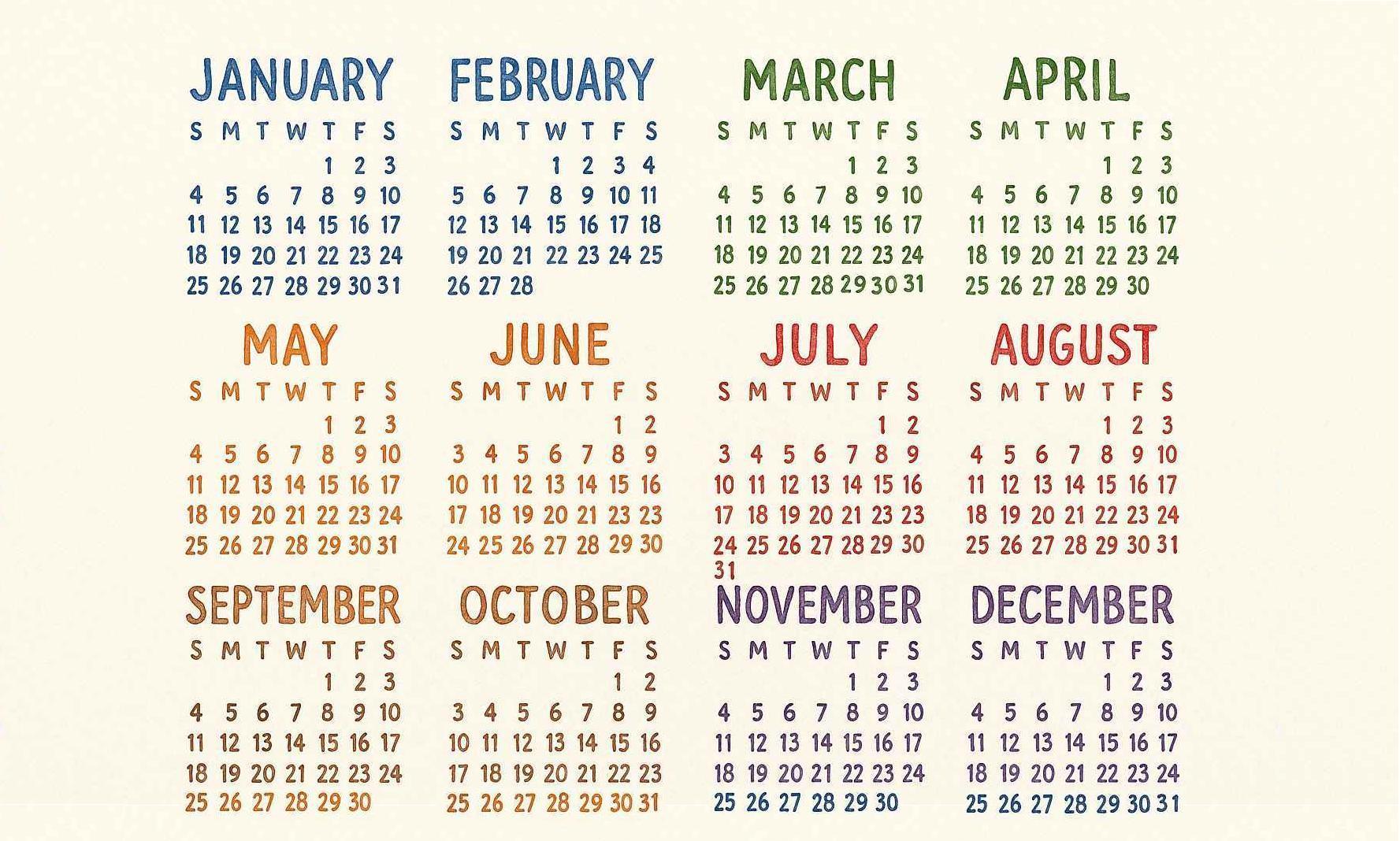
Discover how many seconds are in a year, why not all years are equal, and how time measurement connects science, astronomy, and everyday life.
At first glance, asking how many seconds are in a year may seem like a simple arithmetic question, but it reveals much about how humans measure time. Time, from the steady rhythm of atomic clocks to Earth’s orbit around the Sun, underpins physics, astronomy, and computer science alike.
Knowing the exact number of seconds in a year matters in fields such as astronomy, where precise orbital data are essential; in physics, where time defines motion and change; and in programming, where timestamps and intervals structure digital systems. Even in daily life, it helps with calculations involving data, speed, or frequency.
Yet not all years are equal — Earth’s orbit slightly varies, leading to ordinary, leap, and tropical years, each with a different total of seconds.
The Basics of Time Measurement
Before we can count the seconds in a year, we need to understand how time units are structured and interrelated. The standard system of measuring time is hierarchical: seconds form minutes, minutes form hours, hours form days, and days accumulate into years.
Let’s review these units in order:
1 minute = 60 seconds
1 hour = 60 minutes = 60 × 60 = 3,600 seconds
1 day = 24 hours = 24 × 3,600 = 86,400 seconds
Each step builds on the previous one, and this simple multiplication structure allows time to be converted easily from one scale to another.
The second itself, though seemingly arbitrary, has a precise definition. It is not based on human convention anymore but on atomic properties — specifically, the vibration frequency of cesium atoms. One second equals 9,192,631,770 cycles of radiation from a cesium-133 atom transition. This definition ensures universal consistency and enables synchronization between timekeeping systems across the planet and beyond.
Once we understand the second as a fixed unit, we can easily build up to the larger units — minutes, hours, days, and eventually, years.
How Many Days Are in a Year
A year represents the time it takes for Earth to complete one full orbit around the Sun. However, this period is not an exact whole number of days. For most calendar purposes, we approximate it as either 365 days or 366 days, depending on whether the year is a leap year.
A common (ordinary) year contains 365 days.
A leap year contains 366 days, with one extra day added to February.
The concept of leap years was introduced to keep our calendar aligned with Earth’s orbit. The planet takes about 365.2422 days to complete a solar revolution — slightly more than 365 days. If we ignored that extra fraction, our calendar would gradually drift out of sync with the seasons.
To correct this, the Gregorian calendar uses a leap year rule:
If a year is divisible by 4, it’s a leap year.
Except if it’s also divisible by 100, in which case it’s not a leap year.
Unless it’s divisible by 400 — then it remains a leap year.
So, for example, the year 2000 was a leap year (divisible by 400), but 1900 was not (divisible by 100 but not by 400).
This rule keeps the calendar aligned with Earth’s orbit to within a fraction of a day per several thousand years.
Calculating the Number of Seconds in a Year
Now that we know the length of a day and how many days are in each type of year, we can calculate how many seconds each year contains.
Seconds in one day:
1 day = 86,400 seconds
For a common year (365 days):
365 days × 86,400 seconds = 31,536,000 seconds
For a leap year (366 days):
366 days × 86,400 seconds = 31,622,400 seconds
That’s a difference of 86,400 seconds, exactly one day’s worth of time.
To summarize:
Common year: 31,536,000 seconds
Leap year: 31,622,400 seconds
These numbers give us a solid baseline for most practical and computational applications. However, since leap years occur periodically, it’s often useful to find an average value for a typical year across longer spans of time.
The Average Number of Seconds in a Year
Because leap years happen once every four years (with slight exceptions due to the 100/400 rule), we can calculate an average year length. Over a four-year period, three are common years and one is a leap year.
To find the mean number of seconds in such a cycle:
(31,536,000 seconds × 3 + 31,622,400 seconds ) / 4 = 31,557,600 seconds
So, on average, a calendar year contains approximately 31,557,600 seconds.
This “average” year is often used in astronomical and scientific contexts as the Julian year, defined precisely as 365.25 days. The Julian year serves as a convenient reference because it provides a fixed, uniform duration — ideal for comparing time spans over centuries or millennia without the irregularities introduced by leap year rules.
Variations and Interesting Facts
Although the Julian year provides a convenient standard, the real length of a year—in terms of Earth’s orbit—is slightly shorter.
The Tropical Year
The tropical year, also called the solar year, is the time it takes for the Sun to return to the same position relative to the Earth’s equator (for example, from one March equinox to the next). Its duration is approximately:
365.2422 days
When converted to seconds:
365.2422 days × 86,400 seconds ≈ 31,556,925.6 seconds
This value differs slightly from the Julian year’s 31,557,600 seconds — a difference of about 674 seconds, or roughly 11 minutes.
Over long timescales, these small differences accumulate. That’s why calendar systems require periodic adjustments to stay in sync with astronomical observations.
Leap Seconds
In addition to leap years, timekeepers occasionally add a leap second to account for irregularities in Earth’s rotation. Our planet’s rotation is not perfectly constant — it slows down very slightly due to tidal forces and other natural factors.
When the accumulated difference between atomic time and solar time approaches one second, a leap second is inserted (usually on June 30 or December 31) to keep coordinated universal time (UTC) aligned with the Earth’s position relative to the Sun.
While this change affects global timekeeping standards, it’s negligible for everyday calculations of “seconds in a year.” Still, it highlights how even the most stable systems of measurement must sometimes accommodate nature’s variability.
Astronomical Use
In astronomy, the concept of the Julian year (365.25 days) is essential for expressing time intervals across vast scales — from stellar evolution to orbital mechanics. Astronomers also use longer definitions such as the Julian century (36,525 days) to calculate precession, nutation, and other long-term phenomena.
Everyday Relevance
Even in fields far from astronomy, understanding how seconds accumulate can matter. In programming, timestamps often measure time in seconds since a defined epoch (for instance, the start of 1970 in Unix-like systems). Converting between years and seconds becomes a regular necessity when calculating durations, intervals, or timeouts.
Similarly, in physics or engineering, expressing rates such as frequency, velocity, or decay per second provides a direct way to model continuous processes over time.
Summary Table: Seconds in a Year
Type of Year | Days in Year | Seconds in Year |
|---|
Common (Ordinary) | 365 | 31,536,000 |
Leap | 366 | 31,622,400 |
Average (Julian) | 365.25 | 31,557,600 |
Tropical (Solar) | ≈ 365.2422 | ≈ 31,556,926 |
This table captures the subtle but significant differences between the various types of years. The ordinary and leap years define our calendar, while the Julian and tropical years define astronomical and scientific timeframes.
Conclusion
Counting the number of seconds in a year is more than just a mathematical curiosity — it reveals how humans bridge the gap between the uniformity of atomic time and the subtle irregularities of the natural world.
A common year contains 31,536,000 seconds, while a leap year extends that to 31,622,400 seconds. Averaged over time, a Julian year includes 31,557,600 seconds, and a tropical year, which better represents Earth’s true orbit, has about 31,556,926 seconds.
These differences, though small, are vital for maintaining accuracy in navigation, astronomy, and global communication systems. They remind us that even something as steady as time is shaped by the complex dynamics of the universe.
From a programmer timing processes in microseconds to an astronomer measuring centuries-long cycles, understanding how seconds accumulate into years underscores a profound truth: our concept of time, though measured in uniform ticks, ultimately reflects the elegant irregularity of a living planet orbiting a dynamic star.