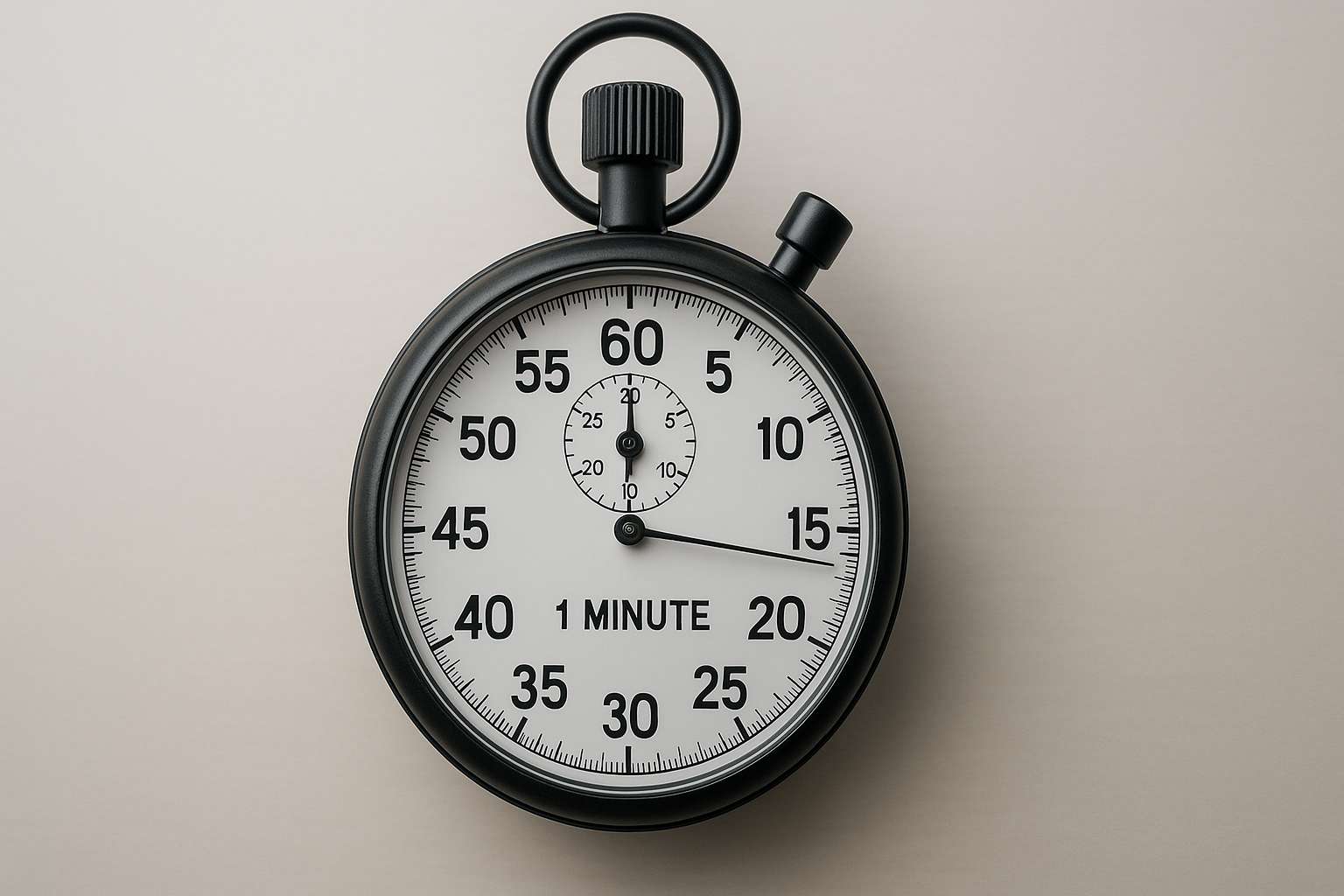
Learn why one minute equals sixty seconds and how this simple time unit connects everyday routines with science, technology, and human history.
“How many seconds are in a minute?” It’s an easy question with a simple answer—sixty. Yet this familiar fact forms the backbone of how we measure and experience time. Every clock, timer, and countdown depends on that fixed ratio between seconds and minutes.
We use it constantly—timing a race, boiling an egg, or waiting for a message to load—often without thinking about it. The idea that one minute equals sixty seconds connects our daily routines with science, technology, and history, shaping how we organize and understand the passing of time.
The Core Fact: 1 Minute = 60 Seconds
The foundation of modern time measurement is the simple but universal truth that one minute equals sixty seconds. It’s a conversion that’s been standardized across the globe, recognized in science, technology, navigation, and everyday life. The number 60 may look arbitrary, but it has ancient roots that explain why humanity settled on this particular structure.
1 Minute = 60 Seconds
To understand this, we have to travel back several millennia to the ancient civilizations of Mesopotamia. The Babylonians used a sexagesimal (base-60) numeral system. Unlike our modern decimal system, which is based on tens, the Babylonians divided things into groups of sixty. This system influenced early astronomy and mathematics and eventually laid the foundation for how we measure angles, geographical coordinates, and—of course—time.
Why base 60? The number 60 is highly divisible. It can be evenly divided by 2, 3, 4, 5, and 6, making it extremely convenient for dividing hours and minutes into smaller, manageable parts. That divisibility made calculations easier for early mathematicians and astronomers, who lacked modern computational tools. Over centuries, the sexagesimal system proved so practical that it persisted even as other numbering systems evolved.
When mechanical clocks became widespread in the Middle Ages, they adopted this inherited structure. Each hour was divided into 60 minutes, and each minute into 60 seconds—a direct continuation of an ancient mathematical choice. So, while our digital watches and smartphones feel thoroughly modern, they’re actually carrying forward a timekeeping legacy that’s over four thousand years old.
Minutes to Seconds Conversion Table
Minutes | Calculation | Seconds |
|---|
0.5 | 0.5 × 60 | 30 |
1 | 1 × 60 | 60 |
1.5 | 1.5 × 60 | 90 |
2 | 2 × 60 | 120 |
2.5 | 2.5 × 60 | 150 |
3 | 3 × 60 | 180 |
3.5 | 3.5 × 60 | 210 |
4 | 4 × 60 | 240 |
4.5 | 4.5 × 60 | 270 |
5 | 5 × 60 | 300 |
5.5 | 5.5 × 60 | 330 |
6 | 6 × 60 | 360 |
6.5 | 6.5 × 60 | 390 |
7 | 7 × 60 | 420 |
7.5 | 7.5 × 60 | 450 |
8 | 8 × 60 | 480 |
8.5 | 8.5 × 60 | 510 |
9 | 9 × 60 | 540 |
9.5 | 9.5 × 60 | 570 |
10 | 10 × 60 | 600 |
Breaking Down Time: Real-World Conversions
Understanding that one minute equals sixty seconds is just the starting point. The next step is applying that knowledge in everyday contexts. Whether you’re programming a timer, analyzing data, or planning an event, converting between minutes and seconds can be surprisingly useful.
Let’s look at a few straightforward examples.
Example 1: 2 Minutes
If one minute equals 60 seconds, then:
2 minutes = 2 × 60 = 120 seconds
This conversion might come up in something as simple as setting a two-minute break during a workout or measuring a two-minute commercial segment on television. In digital systems or time trackers, those two minutes are always represented as 120 seconds.
Example 2: 5 Minutes
Similarly:
5 minutes = 5 × 60 = 300 seconds
Five minutes is an amount of time most people can easily visualize—it’s roughly the length of a song or the time it takes to brew a cup of tea. Yet in many technical fields, it’s more convenient to deal in seconds. For example, engineers designing countdown timers or operating systems often work in seconds because they offer a finer, more precise measure.
Example 3: 0.5 Minute
Now let’s consider half a minute:
0.5 minute = 0.5 × 60 = 30 seconds
This smaller conversion helps illustrate why seconds are such an important subdivision of time. Many events in life don’t fit neatly into whole minutes. A thirty-second advertisement, a thirty-second rest interval during exercise, or a thirty-second hold in yoga—all depend on understanding how fractions of a minute translate into seconds.
These examples might look simple, but they form the foundation of more complex time calculations. In programming, for instance, a developer might need to translate user-friendly input like “5 minutes” into a system-readable value of 300 seconds. In video editing, precise timing—down to the second or even the frame—ensures perfect synchronization between audio and visuals. The same principle applies in scientific experiments, musical performance timing, and countless other disciplines.
Why the Conversion Still Matters
At first glance, the relationship between minutes and seconds might seem like common knowledge. Yet in an age where technology handles most conversions automatically, understanding these fundamentals still matters.
In the digital world, time is measured with extraordinary precision. Computer processors perform millions of operations per second, and network latency is often measured in milliseconds—a thousandth of a second. In aviation and spaceflight, timing errors of just a few seconds can lead to enormous navigational deviations. Even in ordinary daily life, when you record a voice memo, set an alarm, or join a video call, your devices rely on internal clocks that keep track of time by counting seconds.
In education, learning about units of time builds the foundation for more advanced mathematical thinking. Children who understand how to convert minutes into seconds can more easily grasp concepts of proportion, ratio, and rate later on. And in adulthood, whether you’re analyzing productivity, managing schedules, or timing presentations, having a mental grasp of these conversions can help you think more clearly about duration.
Moreover, time perception itself—how long something “feels”—is tied to our understanding of seconds. When someone says “Wait a minute,” they rarely mean exactly sixty seconds, yet our brains interpret that duration through learned experience. Knowing that a minute equals sixty seconds helps anchor our intuitive sense of time in a measurable framework.
A Glimpse at Historical Continuity
It’s fascinating that this 60-based structure has endured unchanged for thousands of years. The second itself was once defined as 1/86,400 of a solar day (since there are 24 hours in a day, 60 minutes per hour, and 60 seconds per minute: 24 × 60 × 60 = 86,400). In the 20th century, scientists refined this definition using atomic measurements—specifically, the vibration of cesium atoms—to ensure extreme precision. Yet despite these advances, the minute-to-second relationship has never changed. It’s one of the rare constants bridging the ancient and modern worlds.
This continuity reflects more than just convenience; it demonstrates how deeply intertwined human systems of knowledge are. Our ancestors’ decision to use base 60 has influenced not only how we tell time but also how we navigate space (degrees in a circle) and define geographic coordinates (degrees, minutes, and seconds of latitude and longitude). Every time you check your GPS or glance at a clock face, you’re engaging with this ancient mathematical heritage.
Conclusion
The rule is simple and absolute:
1 minute = 60 seconds
It’s a conversion that sits quietly at the core of how we organize our world. From counting heartbeats to launching spacecraft, this basic ratio governs countless human activities. Remembering it isn’t just a matter of trivia—it’s a way of connecting with a system of knowledge that stretches across centuries and cultures.
Whether you’re calculating cooking times, designing software, or just trying to be more punctual, understanding the link between minutes and seconds gives structure to how you experience time. It anchors the fleeting and the measurable, allowing us to synchronize, coordinate, and communicate with precision.
So the next time you glance at the clock and see the seconds ticking by, take a moment to appreciate what that simple movement represents. Each second is a fragment of a minute, each minute a fragment of an hour—a seamless chain connecting human history, mathematics, and the rhythm of everyday life.